Below are additional questions and resources that may be useful for faculty, academic advisors, and students.
Resources to Use/Share with Students
There are many resources available on the CBA website relevant to the upcoming changes. Below are direct links to many of them:
What advice should I give to students who are graduating soon?
Each student will have individual circumstances that determine whether the new or legacy requirements may be best for them. While many will benefit from the new pathway, some will be close to fulfilling all of the necessary requirements for the legacy pathway and may find that this suits their situation the best. Questions you can ask to help them determine which set of requirements to use include:
- How close are you to reaching 150 units?
- Is an additional year of schooling an option, financially or otherwise?
- Have you received a job offer or been accepted into a master’s program?
- How much supervised work experience do you have?
- Do you have a preference between classroom learning or on-the-job training?
Will Early Entry to the CPA Exam still be an option with the new rules?
Yes. Early Entry will continue to be an option under the new requirements and will remain unchanged. Students within 180 days of completing the educational requirements, whether legacy or new, are eligible to apply for Early Entry.
If my students take the CPA Exam this year, does that affect which set of rules they can use when they apply for licensure?
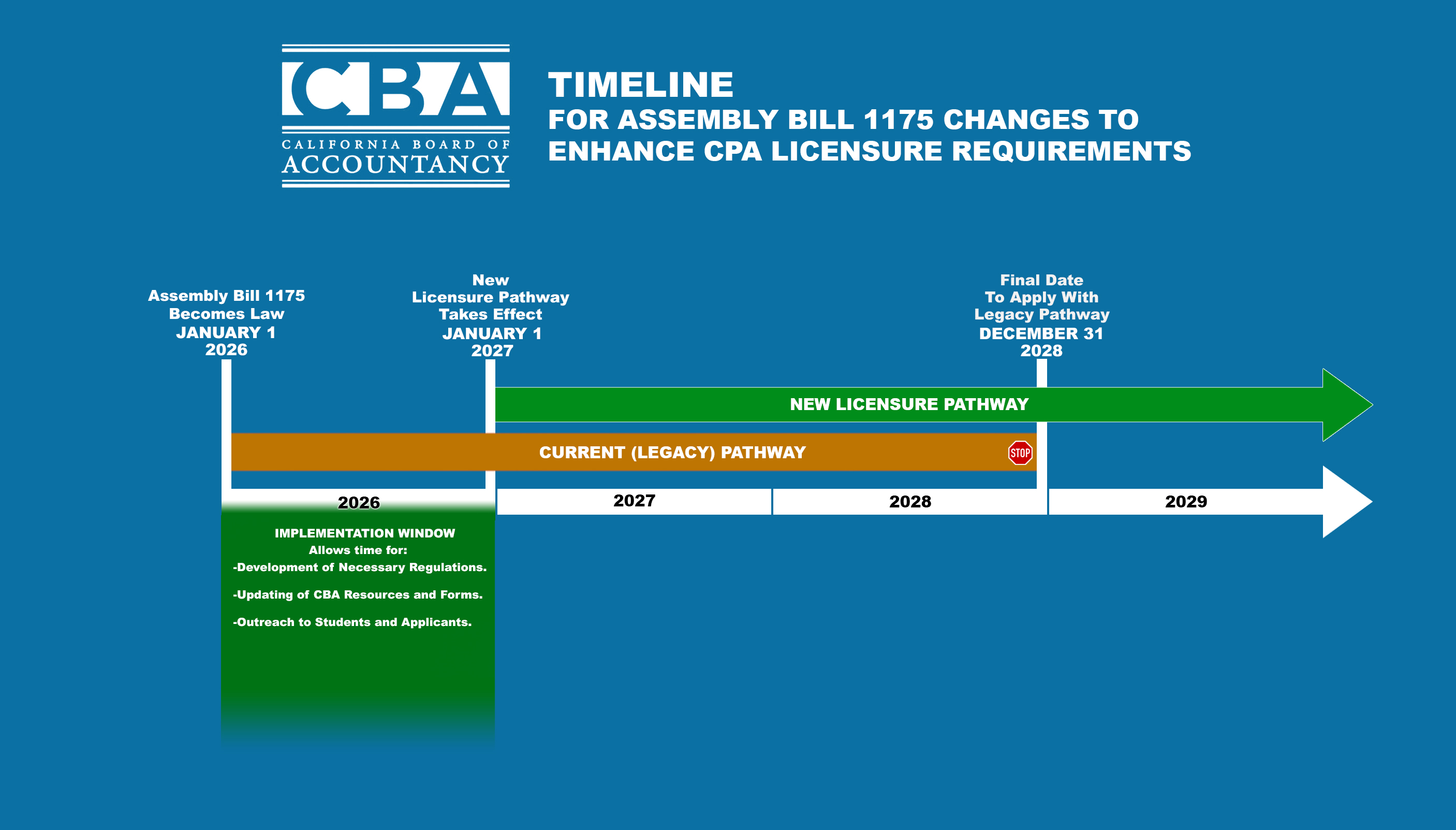
No. Students can sit for the CPA Exam in 2026 using the current requirements, and will then have the option of choosing either the legacy or new pathway when applying for licensure in 2027 or 2028. The rules they use to apply for examination do not have a bearing on which pathway they can use if applying for licensure during those two years, when both are valid.
I know the new examination rules go into effect in 2027, but if a student graduated in 2026 and completed the educational requirements, can they still apply to sit for the CPA Exam under the legacy rules in 2027?
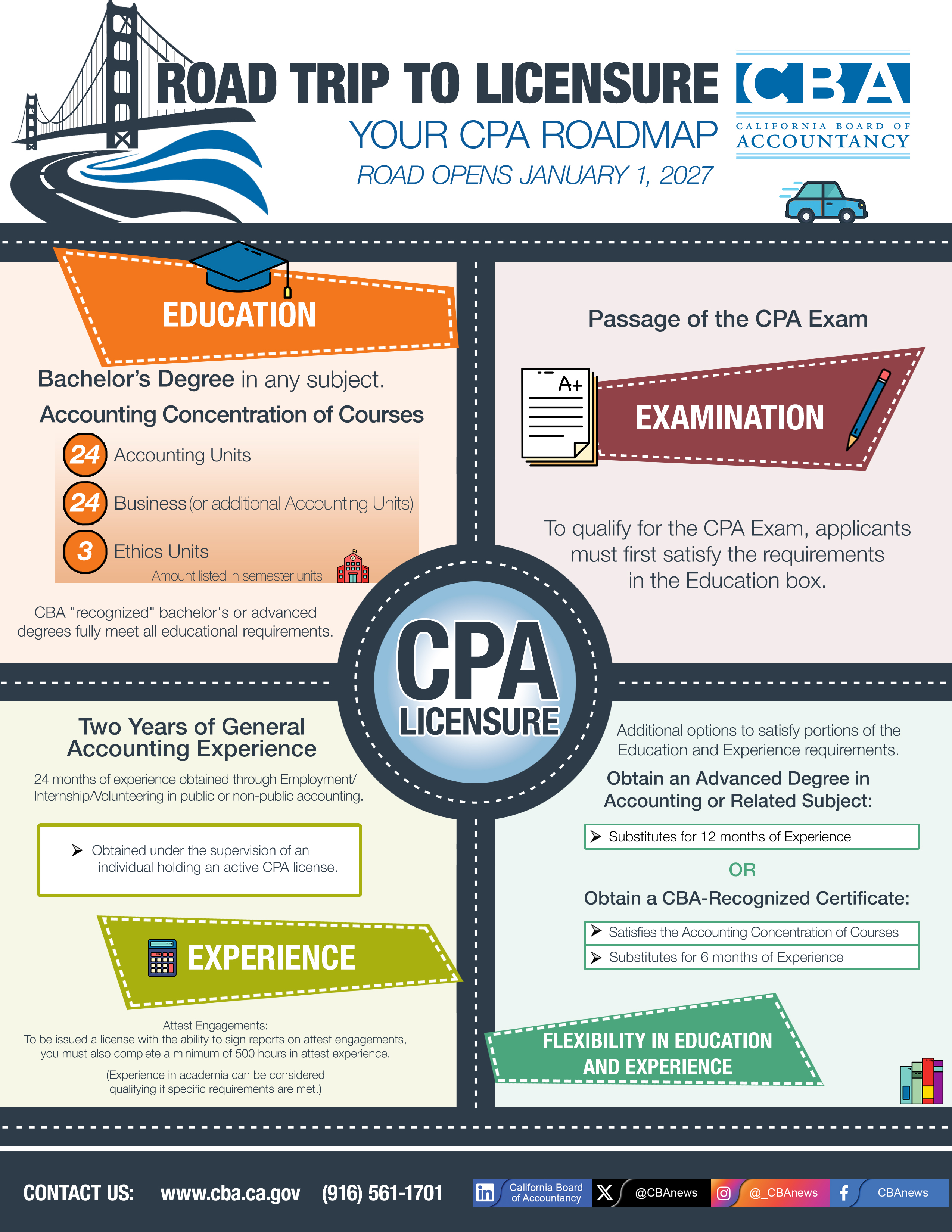
No. The application date is the determining factor for which set of requirements will be used to approve applicants for the CPA Exam. There is no “choice” to be made for examination applications as there is for licensure applications in 2027 and 2028, it is entirely based on the calendar. Exam applications received December 31, 2026, or before, will need to have completed a bachelor’s degree, 24 Accounting units, and 24 Business units to be approved. Applications received January 1, 2027, or after will need to have completed a bachelor’s degree, 24 Accounting units, 24 Business units, and 3 Ethics units to be approved.
If a student is approved to sit for the CPA Exam in 2026 without the 3-unit Ethics requirement and then uses the new pathway when applying for licensure in 2027, doesn’t that mean they can be licensed without taking an Ethics course since the educational requirements will now be the same for examination and licensure?
No. All applicants using the new pathway beginning in 2027 need to have completed the Accounting Concentration of courses (24 Accounting units, 24 Business units, and 3 Ethics units). So even though the educational requirements for examination and licensure are the same for the new pathway, those approved to sit for the CPA Exam in 2026 without the 3-unit Ethics requirement will still need to have satisfied the full educational requirements, including Ethics, to be approved for licensure.