
Examination and Licensure Requirements
The California Board of Accountancy has established requirements to be approved to sit for the Uniform CPA Examination (CPA Exam), and additional requirements to obtain a CPA license after the passage of the exam. It is convenient to refer to them as the “Three Es”: Education, Examination, and Experience.
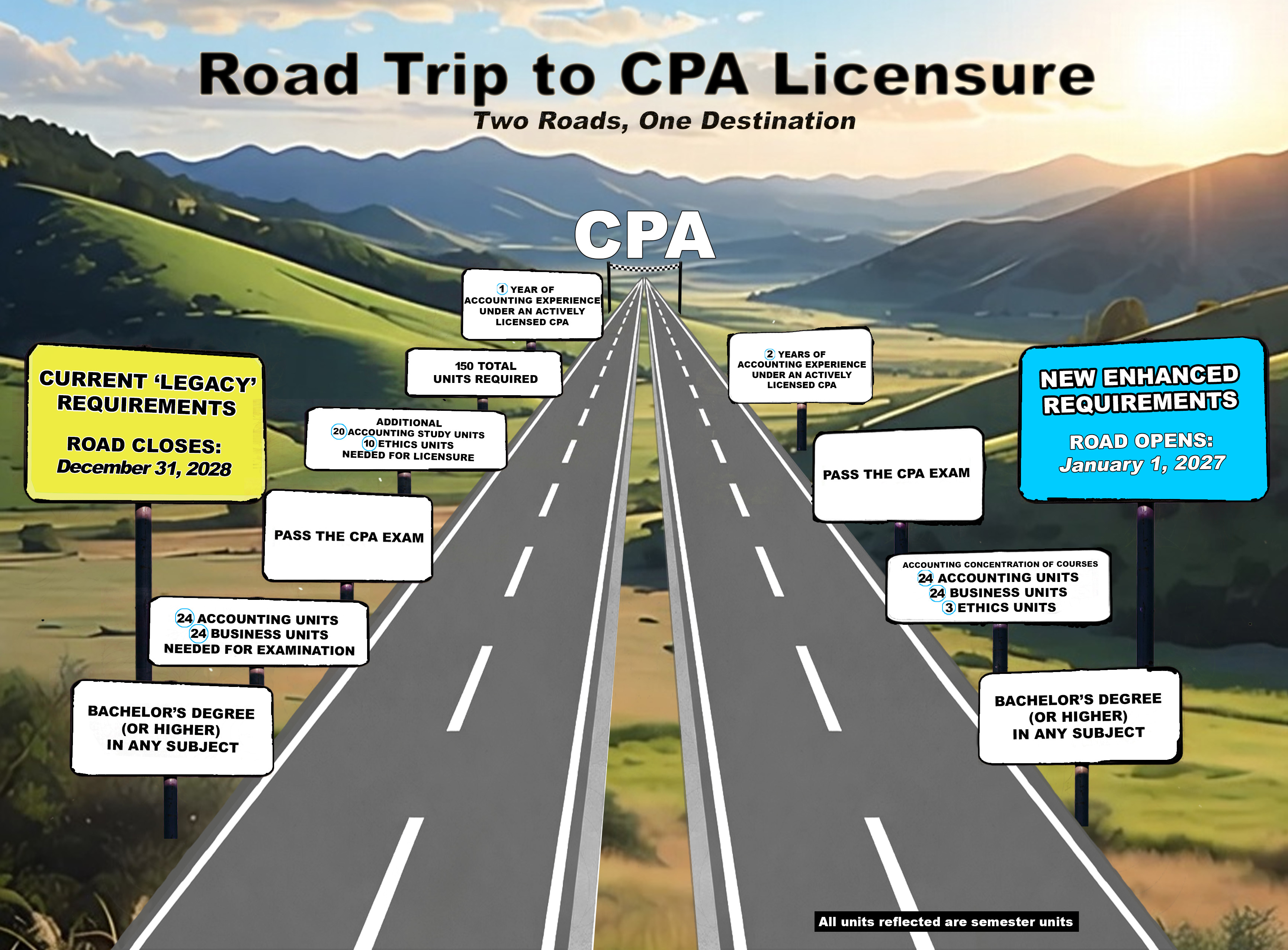
These requirements are changing soon, with a new licensure pathway set to take effect on January 1, 2027, following legislation passed in 2025 (Assembly Bill 1175). The current licensure pathway, referred to as the “legacy” requirements, will remain valid until December 31, 2028, creating a two-year period (2027-2028) when either pathway may be used to apply for CPA licensure in California. Also on January 1, 2027, the requirements to sit for the CPA Exam will undergo a minor change.
Click on an E to reveal the corresponding requirements.
Examination
Education
What are the legacy educational requirements?
Following the successful passing of the CPA Exam, there are additional educational requirements needed for licensure with the current rules. These consist of 20 units of accounting study, 10 units of ethics, and an overall total of 150 units (all of the above are given in semester units).
What are the new educational requirements starting in 2027?
The new pathway to licensure beginning January 1, 2027, removes the additional educational requirements needed in the legacy pathway. This new streamlined set of educational requirements will mirror the requirements to sit for the CPA Exam: A bachelor’s degree (or higher), 24 semester units of accounting subjects, 24 semester units of business-related subjects, and 3 units of ethics (the 24+24+3 is now referred to as an Accounting Concentration of courses). The degree can be in any field. The educational requirements are now the same for examination and licensure.
What are the main differences between the legacy requirements and the new requirements?
During 2027-2028, applicants will have the option of applying for licensure using either the legacy or new pathway, regardless of when they may have applied for or passed the CPA Exam. Key differences in the new rules are the removal of the additional educational requirements needed for licensure (including the total unit requirement), the fact that the educational requirements are the same for both examination and licensure, and an increase to the total amount of experience required for licensure. The legacy pathway requires one year of supervised experience, while the new pathway requires two years.
What is the Accounting Concentration of courses in quarter units?
In semester units, the Accounting Concentration of courses is 24 semester units of accounting subjects, 24 semester units of business-related subjects, and 3 semester units of ethics. For institutions using the quarter system, this will equate to 36 quarter units of accounting subjects, 36 quarter units of business-related subjects, and 4 quarter units of ethics. The Accounting Concentration of courses, along with a bachelor’s degree (or higher), represent the educational requirements in their entirety for examination and licensure.
What courses count towards the Accounting Concentration?
The following table lists the coursework that will be accepted as accounting subjects, business-related subjects, or ethics.
| Subject Areas | Definition |
|---|---|
| Accounting |
All courses taken in a college’s accounting department or program (e.g., “ACCT”). Courses outside of a college’s accounting department or program in the areas of accounting, auditing, taxation, and financial reporting/analysis. |
| Business‑Related |
All courses taken in the following college departments or programs:
Courses outside of the above‑named college departments or programs in the areas of communication and law that are in the context of accounting or business. Excess courses from the accounting and ethics subject areas. |
| Ethics |
Accounting ethics, accountants’ professional responsibilities, audit, and fraud. |
Please note: the Accounting Concentration and the course list above is included in regulations and not yet considered final.
Experience
Quick Hits
Upcoming Events